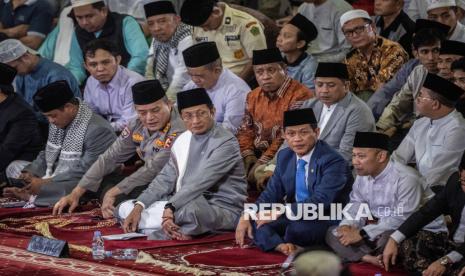
REPUBLICA.CO.ID, JAKARTA— The Minister of Religious Affairs and the High Imam of Istiqlal Mosque, Prof. Nasaruddin Umar affirmed the importance of the message of ecotheology in the commemoration of Isra Miraj State held at the Istiqlal Mosque, Jakarta.
According to him, the theme is very relevant to the conditions of a nation that is being tested by various disasters and environmental crises.
- 3 Negara Islam Ini Riang Gembira dengan Keputusan Amerika tentang Ikhwanul Muslimin
- Pakar Inggris Sebut Trump akan Menyesal Selamanya Jika Serang Iran
- Iran: Kami Siap Perang dengan Amerika Serikat, Lebih Siap Dibandingkan Perang Sebelumnya
“Thank God, we have just implemented Isra Miraj Kenyatta in a timely and good manner,” Nasaruddin said when he met after the event at Jakarta's Istiqlal Mosque on Thursday (15/1/2026) evening.
Nasaruddin explained that ecotheology was chosen as the core of the message because it has a spiritual as well as social dimension. He believes that the trials facing society today should be understood as a test that contains hope and an improvement in the quality of life.
.rec-desc {padding: 7px !important;}“We assure them this is a test, and where there is an exam there is a grade increase. So God will emphasize our class, our society. That is why we should not misunderstand the ordeal, because behind the ordeal there is something encouraging,” Nasaruddin said.
He also hopes that the memorial of Isra Miraj at the Istiqlal Mosque will be widely accessible to the public, both live and through television broadcasts and digital platforms, so that the religious message delivered can reach all layers of the nation.
In the national context, Nasaruddin also emphasized that the message of Isra Mi'raj is highly relevant for strengthening unity and tolerance between religious communities. He believes that the language of religion is universal, especially in terms of environmental concerns.
"So, the language of religion is very universal. All religions agree that the healthier the environment, the healthier the religious community," he said.
He urged all people to avoid wasteful behavior, such as wasting water and electricity. He reminded them that the Quran firmly condemns wastefulness. "Wasteful people are friends of Satan," he explained.
Regarding tolerance, Nasaruddin emphasized that tolerance does not mean standardizing differences or contrasting similarities. "Let the different remain different, and the same remain the same. The important thing is that differences do not distance us from one another," he said.
He described Indonesia as a beautiful "painting of God" that should not be damaged by anyone. "Difference is beautiful, configuration is beautiful," he said.